Shopify Customer Support Outsourcing When It’s Time, and What It Actually Looks Like
Quick clarification before we start, because this phrase confuses a lot of people: if you’re trying to reach Shopify the company about your own account or billing, that’s a different search — head to Shopify’s own Help Center instead. This article is for the other person searching this exact phrase: a store owner trying to figure out who answers your customers’ messages, not who answers yours.
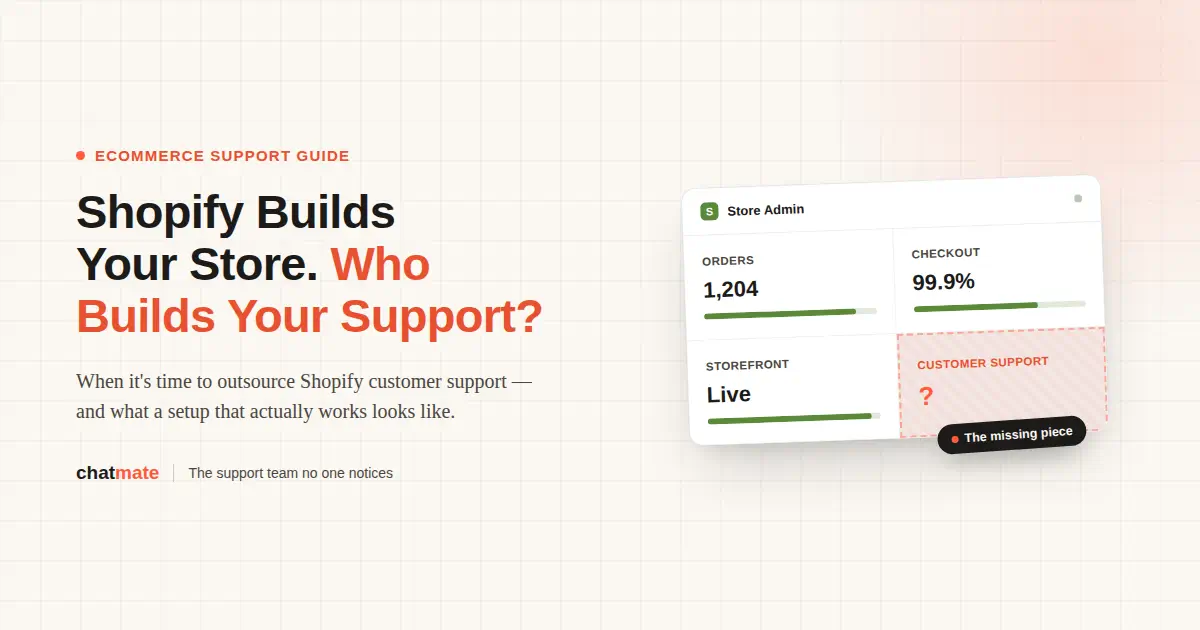
If that’s you, you already know the problem. Shopify gives you a beautiful storefront, a checkout that just works, and an admin panel that handles almost everything except one thing. It doesn’t answer your customers’ emails for you. That part is entirely yours to build, and for most growing stores, it’s the part nobody planned for properly.
The Point Where Most Shopify Owners Start Looking Into This
It’s rarely one big crisis. It’s usually a slow buildup of small ones:
- You’re checking your inbox at 11pm because a customer asked where their order is, and you know if you don’t answer tonight, they’ll leave a one-star review tomorrow.
- A sale or a viral product moment doubled your order volume overnight, and now support messages are piling up faster than you can type replies.
- You’re spending more hours answering “where’s my order” and “do you ship to Canada” than you are actually running the business.
- You hired one part-time helper, but they don’t know your products, policies, or tone well enough to answer without checking with you first so you’re still the bottleneck.
None of these mean your store is failing. They usually mean the opposite you’re growing faster than one person can personally answer every message, which is a good problem to have, as long as you actually solve it.
What Outsourcing Shopify Support Actually Means
Outsourcing” sounds bigger and more complicated than it usually is in practice. For a Shopify store, it typically means handing off some or all of these to a trained external team:
- Email support — order questions, shipping delays, return requests, general inquiries
- Live chat on your storefront — instant answers that keep someone from abandoning their cart over a question you could’ve answered in 30 seconds
- Order and refund handling — processing straightforward refunds and exchanges based on your store’s own policies
- After-hours and weekend coverage — so a message sent at 2am doesn’t sit there until you wake up
The part that actually matters, though, isn’t the task list. It’s whether the replies still sound like you. Done badly, outsourcing feels like a customer got handed off to a stranger reading from a script. Done properly, the customer never even notices the email came from someone other than the store owner.
Why This Is Different (and Easier) Than People Expect
A lot of store owners avoid looking into this because they imagine a call center rigid scripts, long onboarding, a contract that locks them in. That reputation is outdated, especially for Shopify specifically.
Here’s what actually happens with a properly run setup:
You’re never blind to what’s happening
A good support partner works inside your existing helpdesk or inbox not some separate system you have to check yourself. You can see every conversation, every resolution, every pattern in customer complaints, in real time.
Your brand voice comes first, not last
Before a single reply goes out under your name, the team learns how you actually talk to customers casual, formal, funny, whatever it is by studying your past replies and your policies. The goal is that a customer reading a reply has zero reason to think it wasn’t you.
You decide what gets escalated
A trained team handles the repetitive 80% — tracking questions, simple returns, general inquiries — and routes anything unusual, high-value, or sensitive straight back to you. You stay the decision-maker on anything that actually needs you.
It scales with your sales, not against them
The exact week your store gets a traffic spike, a press mention, or a holiday sale rush the week your inbox would normally implode is the week outsourced support is built to absorb, instead of buckle.
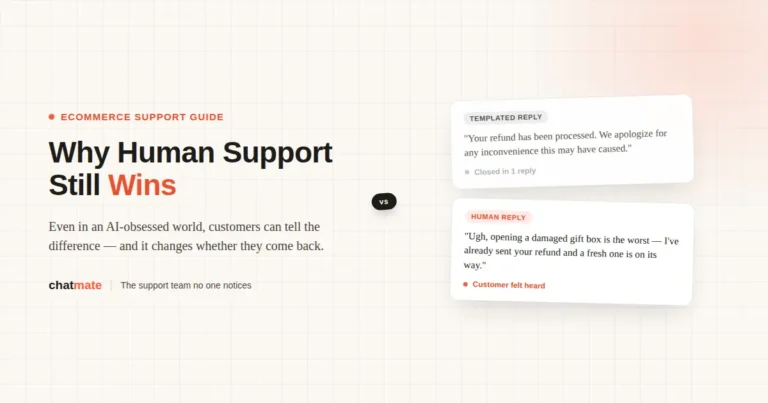
Check Also: Why Human Customer Support Still Wins Ai
What to Actually Look For Before Choosing a Support Partner
Not all outsourced ChatMate support is built the same way, and a bad fit can do real damage to a brand that’s spent months building trust. There are a few important details worth evaluating before moving forward with any service provider.
- Do they train specifically on your brand, or just plug in generic templates? Generic answers are the fastest way for a customer to realize something changed.
- Can you see and review conversations easily? You should never feel like your inbox is a black box you’ve lost visibility into.
- Is there a real escalation process? Ask exactly what happens when a message falls outside normal policy vague answers here are a red flag.
- Can you start small and scale? A trial period or a smaller starting scope tells you a lot before you ever hand over your full inbox.
- Do they understand ecommerce specifically? Shopify support has its own rhythm order syncing questions, shipping zone confusion, discount code issues that’s different from generic call-center work.
How We Approach Shopify Support Differently
This is exactly the gap we built our process around. We work inside the tools Shopify stores already use, learn a brand’s tone and policies before we ever touch a live conversation, and keep store owners fully looped in on anything that needs their judgment instead of guessing on their behalf.
Many of our Shopify clients reach out when their business has grown to the point where customer support is slowing things down, but they’re not yet ready to invest in building and managing a full in-house support team. That middle stage is where we do our best work: covering email, live chat, and order-related messages around the clock, while keeping every reply sounding like it came straight from the store owner.
If your inbox has started to feel like a second job you didn’t sign up for, that’s usually the sign it’s time to talk to someone not necessarily us specifically, but someone who actually understands Shopify support rather than generic call-center work.
The Bottom Line
Shopify will keep building a better storefront, a better checkout, a better admin panel. It will never build your customer support for you that’s always been, and will always be, on the store owner. The good news is that handing it off well doesn’t mean losing control of your brand voice or your customer relationships. Done right, it just means your customers get faster, warmer answers than one exhausted founder could give them alone and you get your evenings back.