Why Human Customer Support Still Wins (Even in an AI-Obsessed World)
Every other tool in the support space right now is trying to convince you that AI can replace your team. We’re not going to do that, because it isn’t what we’ve seen actually work and we say that as a team that runs support for online stores every single day.
Here’s what we’ve noticed after handling thousands of conversations for Shopify, Amazon, eBay, Etsy, and WooCommerce sellers: customers can tell, almost instantly, when they’re talking to something that doesn’t actually care. And once they notice, the trust in that conversation drops, no matter how technically correct the answer was.
That’s not an argument against using smart tools. It’s an argument for being honest about what each tool is actually good at.
What “Human” Customer Support Actually Means
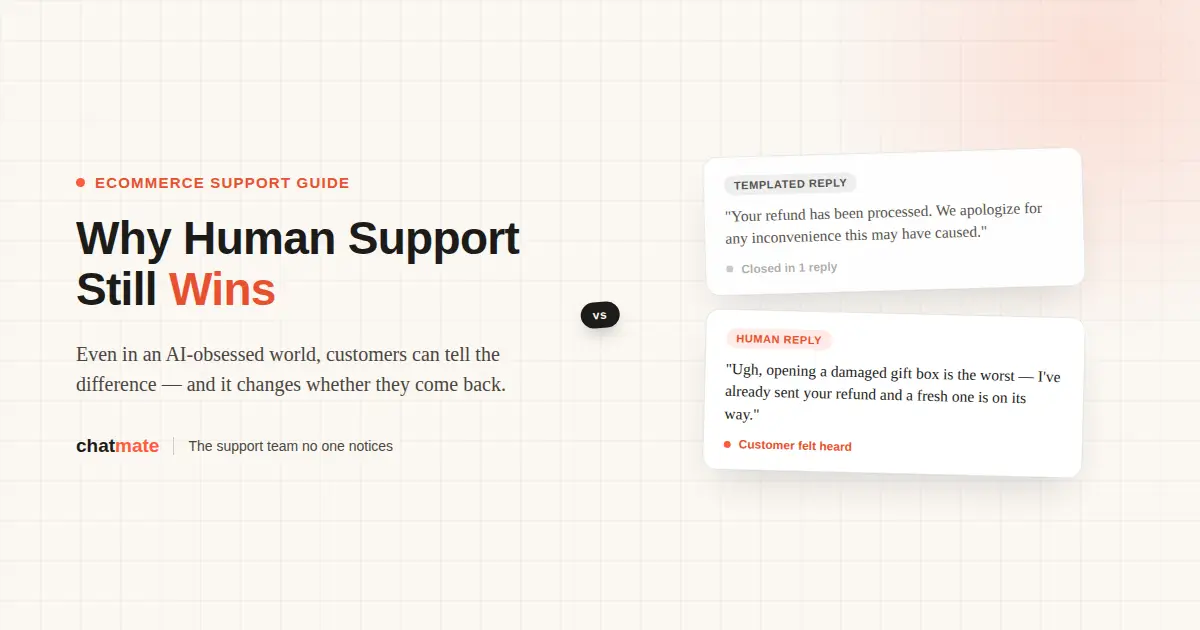
Human customer support isn’t just “a person typed this instead of a bot.” It’s support that responds to the specific situation in front of it the actual order, the actual frustration, the actual customer instead of matching a keyword to a template and calling it solved.
A customer messaging about a damaged package doesn’t just want “your refund has been processed.” They want someone to actually acknowledge that opening a damaged order is annoying, especially if it was a gift, or time-sensitive, or the third time it’s happened. The information might be the same either way. The experience isn’t.
This is the part that’s easy to underestimate when you’re scaling a store: the support experience is often the only direct, personal interaction a customer ever has with your brand. Everything else the product page, the checkout, the packaging — is designed in advance. The support conversation is live, and it’s the moment your brand either feels like a real business or feels like a form.
Why This Matters More As Stores Grow, Not Less
There’s a common assumption that human-feeling support is something small stores can afford and big stores can’t that growth forces you to template everything and lose the personal touch.
We’d push back on that. What actually happens is growth makes it harder to stay personal, not impossible. A store doing ten orders a day can reply to everyone personally without trying. A store doing a thousand orders a day needs a system that’s specifically built to keep that same warmth at scale — which is a genuinely different skill than just answering messages.
This is, honestly, most of what we do for the stores we work with. We’re not hired to send more replies faster. We’re hired to send replies that still sound like the brand wrote them personally, at a volume the brand’s own team couldn’t keep up with alone.
Where Automation Actually Helps (And Where It Quietly Hurts)
We use tools and automation constantly — there’s no version of handling support at scale without them. But the line we pay close attention to is what gets automated.
Automation works well for:
- Pulling up a customer’s order history instantly, so nobody has to ask “what’s your order number” before helping
- Sending tracking updates or shipping confirmations the moment they’re available
- Routing an urgent complaint straight to a senior team member instead of sitting in a general queue
- Answering simple, repeated questions through an FAQ page so customers don’t have to wait for something they could find themselves
Automation works poorly for:
- The actual reply to someone who’s upset, confused, or asking something slightly unusual
- Any situation where the best response depends on understanding the tone, emotion, or intent behind the message.
- Situations where a customer has already had a bad experience and needs to feel heard before they’ll accept any solution
The difference is simple: automate the lookup work happening behind the scenes. Keep an actual person writing the words the customer reads.
Check Also: 12 Customer Service Tips
How We Keep Support Feeling Human, Even at Volume
A few habits we rely on with every client account, regardless of platform:
We learn the brand’s voice before we touch a single conversation
Before we reply to anyone, we study how a store already talks to its customers casual or formal, playful or straightforward so a reply from us reads like it came from the brand itself, not from an outsourced team that just landed.
We give every team member full context before they reply
Nobody on our side answers a message without seeing the order, the previous messages, and any relevant notes. A customer should never have to re-explain something they already said.
We treat every complaint as a real problem, not a ticket to close
A refund request tied to a damaged item gets handled differently than a refund request tied to changed my mind not because one customer deserves better treatment, but because acknowledging the actual situation is what makes support feel human in the first place.
We escalate instead of guessing
If something falls outside what we know about a client’s policies an unusual dispute, a legal question, a high-value order gone wrong it goes straight to the client instead of being handled by best guess. Pretending to have authority you don’t have is one of the fastest ways support stops feeling trustworthy.
We stay honest about who’s responding
If a client wants their customers to know support is being handled by a dedicated team rather than the founder personally, we’re transparent about that. If a client wants the experience to feel seamless and uninterrupted, we match their tone closely enough that it does. Either way, nobody’s being misled about what they’re getting.
The Bottom Line
AI and automation are genuinely useful for the repetitive, behind-the-scenes parts of running support — and we’d never tell a store not to use them. But the actual conversation, the part a customer remembers, is still won or lost by whether it felt like talking to someone who cared, not something processing a request.
That’s the part we specialize in. We handle the volume, the speed, and the systems Shopify, Amazon, eBay, Etsy, WooCommerce, whatever platform your store runs on while making sure every reply still sounds like it came from your team, because as far as your customers are concerned, it did.