Customer Support: What It Actually Means (And Why Most Small Businesses Get It Wrong)
If you’ve ever stared at an inbox full of unanswered customer messages at 11pm, wondering whether to reply now or let it wait until morning, you already understand customer support better than most articles on the subject. You’re not looking for a dictionary definition. You’re looking for a way to stop feeling behind.
So let’s skip the textbook stuff and talk about what customer support really is, why it quietly decides whether a business grows or stalls, and what actually works based on what we see every day running support for Airbnb hosts, online stores, and small SaaS teams.
What Is Customer Support, Really?
Customer support is the part of your business that steps in when something doesn’t go the way a customer expected. A missing order. A late delivery. A login that won’t work. A refund that should’ve already happened.
It’s reactive by nature someone has a problem, and support exists to solve it. That’s different from the broader idea of “customer service,” which covers the entire relationship a customer has with your brand, from the first ad they saw to the thank-you email after their tenth order.
Here’s a simple way to think about it: customer service is why you treat customers well. Customer support is how you actually fix what’s in front of you right now.
An online store’s customer service is the whole shopping experience — clean product pages, easy checkout, a thank-you email after purchase. Customer support is what happens when a package shows up damaged and someone needs to deal with it right away.
Every business has customer service, whether they think about it or not. Not every business has a dedicated support function but the ones that do tend to grow faster, because they’re not losing customers to easily solvable problems.
Why This Actually Matters for Growth
Here’s the uncomfortable truth most customers don’t complain when something goes wrong. They just leave.
A single bad support experience is often enough to push someone toward a competitor — and they rarely tell you why. They just stop ordering, stop reordering, stop coming back. The store owner is left wondering why repeat purchases dropped, without realizing it was a three-day-old unanswered email that did it.
On the flip side, fast and thoughtful support does something interesting: it builds more loyalty than if nothing had gone wrong at all. A customer whose delayed-order question gets answered warmly and quickly often becomes a more loyal customer than one who never had a question. People remember how they were treated when something was inconvenient.
For small businesses specifically, support has an outsized effect because there’s no brand reputation cushion yet. A large company can absorb a bad review. A new Shopify store or a small Etsy shop can’t — one slow response during a busy sale weekend can cost a five-star rating, a repeat buyer, or a customer who would’ve referred five more people.
What Actually Works: Practical Support Strategies
Forget generic “be nice to customers” advice. Here’s what genuinely moves the needle, especially for small and growing businesses.
1.Respond faster than feels necessary
Most customers aren’t expecting an instant reply they’re expecting some reply within a reasonable window, and “reasonable” keeps shrinking. A question asked through live chat or marketplace messaging that sits for six hours can feel, to the person waiting, like being ignored.
You don’t need a 24/7 team to fix this. You need a system — whether that’s a shared inbox with clear ownership, an after-hours plan, or outsourced coverage for the hours your team is asleep that guarantees nothing goes untouched for too long.
2.Solve the actual problem, not just the ticket
There’s a difference between closing a support ticket and actually solving someone’s problem. If a customer on your Shopify store asks how to track their order, answering the literal question is fine. But if a dozen customers ask the same thing in a month, the real fix is sending tracking links automatically — not just answering faster each time.
Good support teams notice patterns. They flag recurring confusion back to the store owner instead of just resolving the same issue over and over in isolation.
3.Let your tone do some of the work
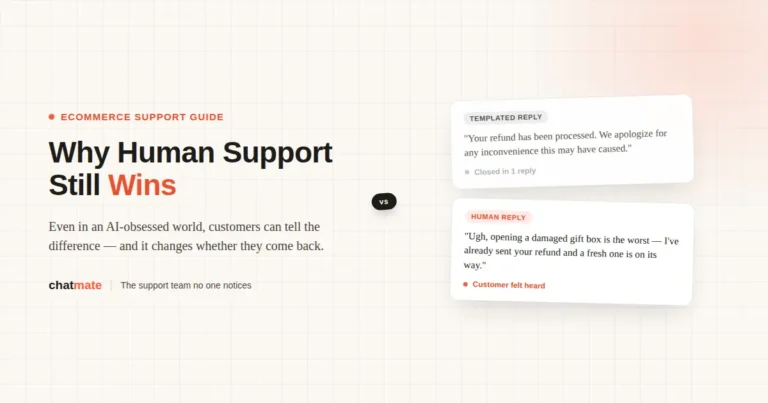
Customers can tell the difference between a templated response and someone who actually read their message. You don’t need every reply to be a novel, but a reply that uses the customer’s name, references their specific situation, and skips the corporate phrasing (“We apologize for any inconvenience this may have caused”) reads as more human and more trustworthy.
This matters even more when support is outsourced. If a customer can tell the tone shifted formal where the brand is usually casual, or robotic where the brand is usually warm it breaks the experience, even if the actual problem still got solved.
4.Don’t make the customer repeat themselves
Few things frustrate people more than explaining their issue, getting transferred or escalated, and having to explain it again from scratch. If your support tool lets you see order history, past messages, or account details, use that context every time. It turns “tell me what’s wrong into I can see what happened here’s the fix, which feels dramatically more competent from the customer’s side, even if the actual solution takes the same amount of time.
5.Make it easy to reach you on the channel they already prefer
A customer messaging through Instagram DMs doesn’t want to be told to please email us instead. Increasingly, people expect to reach a business wherever they already are email, live chat, WhatsApp, or messages through the marketplace itself, like Amazon’s Buyer-Seller Messaging or Etsy’s conversation tool. Businesses that consolidate these into one place, so nothing falls through the cracks, tend to respond faster & miss less.
6.Build a simple self-serve option for repeat questions
Not every question needs a human. A clear FAQ page, a shipping policy page, or a short knowledge base article can resolve simple questions instantly, at any hour, without anyone typing a reply. This isn’t about replacing human support it’s about saving it for the situations that actually need a person, instead of burning hours answering “where’s my order” for the fortieth time.
7.Know when to escalate & do it without delay
Some situations are above a support agent’s pay grade by design: a major refund dispute, an angry customer threatening to leave a public review, a legal question. The strongest support setups have a clear, fast path for escalating these to the business owner, instead of a support rep guessing or stalling. Customers can tell the difference between “let me check on that and get right back to you” and being quietly ignored while someone figures out what to do.
8.Treat every interaction as a chance to learn something
Support conversations are some of the most honest feedback a business gets. If customers keep asking the same question about sizing on a product page, that’s a sign your description is missing something. If customers keep asking about a return policy that’s “right there” on your site, maybe it isn’t as clear as it seems. Businesses that treat support as a feedback loop not just a cost center tend to fix root problems faster than competitors who only ever treat symptoms.
A Quick Real-World Example
Picture two nearly identical online stores same niche, same price point, same product photos, one running on Shopify and the other on a WordPress/WooCommerce setup. One owner answers customer emails whenever they get a chance sometimes within the hour, sometimes the next morning. The other has a system: every message gets acknowledged within minutes, order and tracking questions are answered before the customer even has to dig through their inbox, and common questions about sizing, shipping, or returns are handled before they ever pile up.
Six months later the outcome is usually clear 1 seller has more five-star reviews, fewer Where’s my order? complaints, and more returning customers. The products were identical. The customer support wasn’t.
This pattern shows up the same way on Amazon and eBay storefronts, where buyer messages and return requests are timed and tracked by the platform itself slow replies don’t just lose a sale, they can quietly hurt seller ratings. It shows up on Etsy, where buyers often expect a more personal, handmade-shop feel and notice immediately when a reply sounds copy-pasted. And it shows up just as clearly on self-hosted WordPress stores, where there’s no marketplace algorithm watching response times — only the customer deciding, on their own, whether to come back.
This is the part that’s easy to underestimate: support isn’t just damage control. For small online sellers especially, it’s often the single biggest lever for turning one-time buyers into repeat customers without spending another rupee on ads.
The Bottom Line
Customer support isn’t just answering messages. It’s the part of your business that decides whether a frustrated customer becomes a lost one or a loyal one. It’s also one of the few areas where a small business can genuinely outperform a much bigger competitor not with a bigger budget, but with faster replies, more personal answers, and fewer dropped messages.
If you’re running a growing online store and finding it harder to keep up with support volume — whether that’s Shopify or WooCommerce order emails, Amazon and eBay buyer messages, or Etsy conversations you don’t have to solve it by working later. You can build a system, or bring in a team that’s already trained to sound like you, around the clock.